Showing posts with label Technology. Show all posts

Saturday, May 5, 2012

An Electric Rant


With gas at well over $4/gallon, a 120 mile/day commute and a car with 177,000 miles on it, it should be no surprise that I'm shopping for a new car. I've always loved cars - the engineering, the speed, the wind in your face and the g-forces as you accelerate fast, corner hard and brake even harder (like when you see the radar gun around that blind bend in the road). I fit right in with the Top Gear guys in England - I would give anything to be The Stig.

This is a very bad time to be a car nut. Engineers are making better cars than ever before - they look great, handle great, accelerate well and are vastly more comfortable and better built than any previous generation of cars. Sounds great, right? How could this possibly be a bad time to be car shopping??

Unfortunately, the other side of this wonderful time more than cancels the great work of those engineers.

Let's start with the promise of eliminating the high cost of gas with an electric or hybrid car. Most of the major car manufacturers now have hybrid models, and more all-electric cars are appearing. By far, the most popular car on the road in SoCal is now the Toyota Prius. Remember my praise of the looks, handling, acceleration and build quality of new cars? Yeah - forget that when talking about the Prius. They are butt-ugly. They accelerate like a hippo on a moped. The suspension is soft and the seats are hard & uncomfortable - and worst of all, they are just crappy little cars with poor fitting plastic and a cheap feel. If it wasn't for the "Hybrid" badge on the back, they wouldn't be able to sell 2 of those little turds a year.

But, you say, they are a Hybrid, so it's all worth it because of the great gas mileage, right??

The 2012 Prius is rated at 51 MPG city and 48 MPG highway. Hey that's pretty good! Right???

Well, yes - and no...

There is no question that the hybrid dramatically improves the MPG during city driving. The Toyota Yaris, the other small econobox from Toyota, is rated at 30 MPG city. If you drive primarily on city streets, a hybrid is a great choice - but who in SoCal drives only on city streets? On the highway, the Toyota Yaris is rated at 38 MPG. The Prius is certainly better, but the gap is much narrower. Let's do some math - if you drive 20K highway miles a year (that's well above average), and gas is $4.25/gallon (that's above the current average) and you drive a Prius, then you will use 417 gallons and spend $1,772 on gas. With the Toyota Yaris, you will use 526 gallons of gas and spend $2,236. The savings after 1 year is therefore $464. After 10 years (assuming the price of gas stays the same - admittedly very unlikely!) you will have saved $4,640. According to Edmunds.com, a base model Prius with typical options sells for $24,711 and a base model Yaris with similar options is $15,838. That's a difference of $8,873!!! Factor in the additional interest cost if you finance the purchase, and the cost premium for buying a hybrid is even more.

Now, I think both the Toyota Prius and Yaris are crappy, ugly little cars. I want better! Go big or go home! Staying in the Toyota line, let's move up to the Lexus CT200H vs the Lexus IS250. Once again, city driving is no contest - the hybrid CT200H is rated at 35 MPG in the city compared to the IS250 rating of 19 MPG. On the highway, the CT200H is rated at 34 MPG and the IS250 at 28 MPG - a difference of only 6 MPG - and less than the difference between the Prius and Yaris. The savings in gas for the luxury hybrid works out to be $536, and the price difference between the two similarly equipped Lexus is $3,553. OK, so moving up to the premium line made the hybrid appear to be a bit more financially viable - but only because the total cost you are spending on your transportation is now much, much higher - and it's not like the hybrid is actually saving you very much more money - the savings is still very small compared to the price premium. In terms of performance, the hybrid shows it's real weakness - the CT200H does 0-60 in 8.7 seconds, while the IS250 can get there in 7.5 seconds. The IS250 also has better braking from 60-0 at 113 feet compared to the CT200H at 125 feet.

How about the new all electric cars? Good luck. The Nissan Leaf has a range of 73 miles. That's not a misprint - you need to charge the batteries every 73 miles. It will take 8+ hours to charge the car from a standard 110v electrical outlet. The price for that much inconvenience? $36,000 for a base model. But at least electric cars have excellent acceleration, right? Nope - the Nissan Leaf does 0-60 in 10 seconds, slower than a $15,000 Yaris. The Chevy Volt is one of the hot new electric cars - it is not a pure electric - it also has a small gasoline engine, so it is really a hybrid - but unlike the Prius, the Volt can be driven purely on electric power, and can be recharged from a electrical outlet, so it can be driven without using any fuel - as long as you only drive less than 50 miles between charges. Once you are out of battery juice, you will run entirely on the gas engine, and your mileage will be in the 30-35 MPG range. The cost of the Volt with typical options: $42,675!!!

Compare all of this nonsense to a nicely equipped "non-green" all-gas Hyundai Sonata. The Sonata looks good (to me), is very well built, very comfortable inside, handles well on the road and is quick - 0-60 MPH in 7.9 seconds. The Sonata's 2.4L engine is rated at 24 MPG city and 35 MPG on the highway. A typically equipped base model Sonata is a very affordable $20,635. That's over $4K less than the crap-box Prius. I'm sorry - I love the planet and all, but I am NOT going to be sucked-in to the marketing hype and eco-pressure to buy an over-priced, under-performing and ugly little smug machine like the Prius, and I would much rather spend 10 minutes at the gas pump rather than wait 8+ hours for my batteries to recharge so I can go get a gallon of milk.

And that's the real problem for car lovers today. We have to look like social misfits just to make the sound, logical decision of NOT buying a hybrid or electric car. I'm tired of listening to co-workers who think they made a great decision in buying a Prius, and I'm REALLY tired of having to weave my way through the sea of smug Prius drivers poking along on the freeway with no concern for getting the hell out of the way of people who have chosen to drive a car that doesn't need to plod down the road like a hippie microbus on the way to a Grateful Dead concert.

I think I'll wait for this to be the electric car I can buy...


For all you Prius drivers out there - do me a favor - look in your rear view mirror occasionally, and if you see me back there, get the hell out of the way!!! Thank you.


Saturday, March 3, 2012

Death to Spammers

I have suddenly started seeing a huge increase in spam on my personal email address.  I can't prove it, but I suspect my hosting company changed something and the SpamAssassin software they run is hosed up.

So, I'm going to try something new - a hosted spam filtering service.  They filter your incoming mail for free - and all they ask is that you give them a link on a public web site.  Seems fair to me - so here you go:

stop spam

I hope this works!

Friday, December 16, 2011

Artificial Intelligence


No, this is not another story about killer robots....

I just finished "Patches", a science fiction short story by Lesley Choyce.   It is about a dystopian society where all human beings were connected to a central information store called "The Source" through a skin patch that provided a direct interface between the human brain and "The Network".  The Source was sentient, and had taken control of The Network and all humans, issuing pain and information through the patches to maintain order in society.  An android appendage of The Network made a statement that all human beings were equal and they were no more than a collection of their biological parts.  His belief was that because the Network contained all the information known to humans (by tapping directly into their brains and all other data storage devices) it also possessed all the actual knowledge in the world - because knowledge and information were identical.  A small group of humans, struggling to free themselves from the Network, completely disagreed, and said that knowledge was much more than simply a collection of information.

I think this story points out a very likely failure in a machine ever achieving true artificial intelligence.  It seems very plausible to me that a machine would be unable to discern the difference between information and knowledge.  I think this concept may be one of the fundamental barriers that must be overcome for any machine intelligence to achieve sentience.

Unfortunately, many corporations are falling into this same trap - and I believe IT professionals have merrily led the corporate leaders down this false trail.  Since the beginning of the computer age, we have been chanting the power of information - and we have said that without good information, a company cannot make good decisions and is doomed to failure.  Heck, even our own names for what we do: "Information Technology", "Information Services" or even the old "Data Processing" show that we are focused on the collection and management of the information - not the knowledge that information represents.

There is no better example of this than the typical corporate HR form used to apply for a new job.  A couple of years ago, I wrote about the ridiculous amount of information an applicant must provide in order to apply for a job using the typical online recruiting systems.  I would claim that most of this data provides nearly zero additional knowledge to the company - it certainly is not used during the typical hiring process, or if it is, it is used only in the most crude way to filter out candidates and reduce the size of the potential candidate pool.

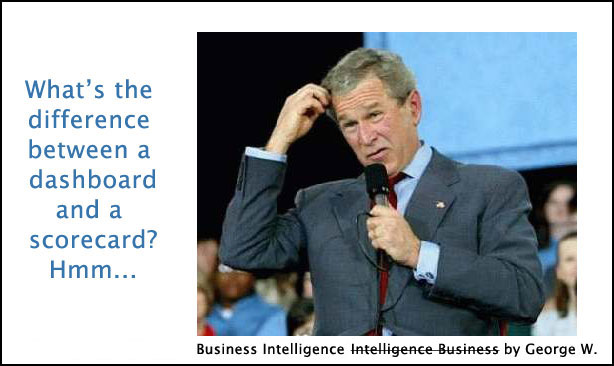
The same is true for a vast amount of other information gathered from all across the corporation.  There are massive amounts of data being collected, massaged and reported that provide little or no additional knowledge to the company.  This represents a huge expenditure of corporate resources for absolutely no business value.  It also demonstrates a fundamental problem within many corporate boardrooms: the inability of senior business leaders to define the key metrics that are used to run their company.

There are certainly some companies that have defined their Key Performance Indicators (KPIs), and they really do use those metrics to make tactical and strategic decisions.  If you work in one of these companies - you are fortunate - count your blessings.  It was only when I moved to a company that did not have defined KPIs that I learned that it was even possible to run a large corporation without good business metrics.

What is really sad is that it seems these companies do not understand or recognize the issue.  To them, sitting in an Executive Team meeting and suddenly asking:  "How did the flood in Thailand affect our sales to Southeast Asia compared to how our sales were affected in 1980 by the election of Ronald Reagan?" is a critical data point that will drive all future corporate strategy.  The rest of the executives turn to the CIO and say:  "That's a simple report, you have all the data, right?"  And the CIO's response is (of course) "I'm sure we do, we'll have that for you later today."

After delaying 3 critical projects and pulling four straight all-nighters, the report is finally produced and scheduled to run weekly for the executive team meetings.  However the CIO is mad that your data warehouse and business intelligence tools are so poorly implemented that you couldn't meet his expectations.  When the report is sent to the executive team, there is a "thank you" reply from the CEO - and nothing is every heard about that report again.  Six weeks later, you check the logs for that report, and you find that there has been exactly one person who has ever accessed the new report - the IT analyst who was tasked to make sure all the reports run successfully every week...

OK, the report criteria I used for this example was fictional, but everything else was a regular occurrence.  The senior leadership believed it was perfectly acceptable to ask any random "I wonder..." question and the data would be available and the report easily produced.  It never occurred to them how disruptive their seat of the pants management style was to everyone involved in producing those ad-hoc reports.  And even worse, the ad-hoc reports were often not actually used for anything - they were apparently just an idle thought that wasn't actually the basis of any decision making process.

In some companies, this behavior is combated by purchasing more ad-hoc reporting tools in an attempt to provide the executives and their staff the ability to run their own reports.  That may work in larger companies where their is enough staff to cater to the executive whims - but not in companies that run much leaner.  Unfortunately, expecting executives to do their own ad-hoc reporting is a foolish hypothesis - it's simply NOT going to happen, and the result is the worst of all worlds - you have spent the money on the easy to use tools, you do not have the staff to do the ad-hoc analysis, and the executives are still asking the questions and looking at the CIO to provide the answers.

Now, let's say that you are finally fed-up, and you decide to launch a new business intelligence initiative.  The consultants tell you that step 1 is to define the KPIs that are used to drive the business decisions.  So, you go to the executives, and you ask:  "What are the key metrics that drive your decision making processes?"  You get a blank look, followed by the typical executive 2-step shuffle that makes this your fault for not providing the executive with the proper information for them to make *this* decision.  You have no choice but to beat a hasty retreat and rethink your chosen career path.

When you get back to your office and calm down, you realize a startling fact:  the executives do not really know how they make decisions.  They *are* making decisions - they do it every day in all parts of the business - but they simply can't define what information they use to do it.  Even more frightening, you also realize that if they have not defined those metrics, there is absolutely no way the decisions they do make can be consistent, logical or data driven.  Good grief, no wonder the decisions often seem to be somewhat random - they *are* somewhat random!

In an ideal world, the key business decisions are driven by specific data elements and threshold values.  Above the threshold, the decision is X, below the threshold, the decision is Y.  If you have all the key operational metrics defined, your business can almost run on remote control.  At least, that's what the business consultants and best selling authors say.  Of course, in the real world, there are always un-quantifiable factors that influence the decision.  It might be office politics, shareholder sentiment, perceived risk or simply a hunch.    However, should you let those influences drive your decision in the face of opposing data?  Of course, if you do not have the data (opposing or otherwise), then those influences are all you have.  That doesn't seem to me to be a prudent business strategy.

Developing KPIs really is difficult, I'm certainly not trying to say it is easy, because it is not.  You must force yourself to determine the key operational decisions, and also determine what data you use to make those decisions.  In addition, you *must* also determine the threshold values for each data element.  Without a defined threshold to tell you whether to move the lever left or right, you are simply looking at data without a business context.  You may find that some of your decisions are based on trends - upward, flat or downward - once again, without knowing how you will use the data, seeing the data will not help you make the decision.

I suspect that some executives do not really want to define their decision making processes.  They may believe, or want others to believe, that their decision making is a combination of unique insight, luck and magic that is only found within their well-paid head.  If I was an investor in a company with leadership like that, I would be very, very nervous.  I don't want to invest in unique insight, luck and magic - that might be OK for betting the longshots at Santa Anita horse races, but not my 401k money!  I want leadership that can articulate how they run the business, and I want to know that they aren't just flying by the seat of their pants.

I urge all business leaders to take a critical look at the information they are collecting, processing and reporting.  If you can't directly link the data to a specific business decision - then stop collecting and reporting on that data - it's a waste of your precious resources.  Encourage employees to question all requests for new data and new reports.  "Because the VP wants it" is NOT a good reason.  Every report should have a purpose, and "I've always run that report on the 3rd Tuesday of every month" is NOT a valid business purpose.  Don't just collect information - always strive to create knowledge.                            

Thursday, December 8, 2011

The Rise of the Machines


As most of you know, I'm a long-time fan of science fiction.  Intelligent robots are a huge part of the science fiction universe.  The concept of a robot is very old - accounts and stories relating to mechanical automatons have been found in ancient Greece and the Zhou Dynasty of China.  I suspect the idea is actually much older.  It would not surprise me if soon after man was intelligent enough to figure out the concept of "work", we then tried to figure out a way to have someone or something else do the work for us.  So, in this post, I'm celebrating some of my favorite robots and sentient machines from books, movies and TV.

Caveat:  This is MY list - my opinions.  If you disagree with me because I left your favorite 'bot off the list or I don't have them ranked the same way you would - too bad.  Honestly, I really don't care what you think - go make your own list!

10. T-800 Terminator - First up, in 10th position is that unstoppable metallic man - The Terminator.  I'm actually partial to the inner metal frame version of the T-800, without the Arnold outer-skin.  The skeleton just seems so much more menacing.  You might wonder why I have chosen the original T-800 instead of the later, liquid metal T-1000 or the really hot but deadly female T-X.  The answer is obvious:  because the T-800 ultimately kicked their liquid asses!  Even though the T-800 was the good guy in the second & third movies, there's really not a lot of redeeming qualities to the Terminator - he's your basic killer robot.  Don't look here for any insights about the human psyche - he just kills things.


9.  Andrew Martin - This robot is from a book titled "The Bicentennial Man" by the undisputed king of robot stories, Dr. Isaac Asimov.  It is NOT about the horrible Robin Williams film of the same name.  Asimov created the terms "robotics" & "positronic brain", and in perhaps the greatest concept in all of SF, the "Three Laws of Robotics":

1. A robot may not injure a human being or, through inaction, allow a human being to come to harm.


2. A robot must obey the orders given to it by human beings, except where such orders would conflict with the First Law.


3. A robot must protect its own existence as long as such protection does not conflict with the First or Second Laws.


However, it is not these laws that cause me to include Andrew Martin, in fact, he was not the first Asimov robot with the Three Laws.  No, what sets Andrew Martin apart is that over a period of 200 years, he actually *becomes* human.  He began as a fairly mundane household servant android, but he had something no other robot had - a spark of creativity.  With the help of many organic upgrades and a brilliant legal team, Andrew eventually proved that he was indistinguishable from any other human being.  The court still refuses to declare him legally human because his brain does not age and eventually die.  So, Andrew takes the final fateful step - and asks a robot surgeon to allow him to age and die.  However, the robot surgeon refuses - because to it, Andrew *is* already human and the operation would violate the First Law.  Andrew manages to convince the robot surgeon that he is not human, and finally *does* become human in the eyes of the court.    Of course, to the people who have known Andrew for 200 years, he has ALWAYS been human...


8. Gay Deceiver - Gay Deceiver is not strictly a robot, and she is definitely not homosexual - she is a sentient computer.  She also happens to be the navigation computer in a Ford car/aircraft/spacecraft/time machine/universe translating machine.  Gay Deceiver was the creation of Robert A. Heinlein, arguably the greatest of the Grand Masters of SF, from the book "The Number of the Beast".  She is a very special craft - able to move between universes as well as time and space.  In addition, Gay Deceiver is also a typical RAH female character - smart, funny, sarcastic and she loves to talk dirty.  At the beginning of the story, she is not sentient - but thanks to programming upgrades and some magic from Glinda the Good while visiting Oz, Gay Deceiver becomes much more than just a flying car.

7. H.A.L. 9000 - In 7th spot, we have another sentient computer, the H.A.L. 9000 (Heuristically programmed ALgorithmic computer) from yet another of the Grand Masters of SF, Arthur C. Clarke in the very well known book "2001: A Space Odyssey" and the outstanding Stanley Kubrick film of the same name.  HAL was a GREAT villain - never showing ANY emotion as it systematically kills the entire crew of the spacecraft, except for a single crewman.  On one level, HAL is just another killer robot - yet its soft, non-emotional, non-threatening manner is anything but evil.  We must also remember that Arthur C. Clarke wrote this story in 1968 - before man had set foot on the moon and only 7 years after Alan Shepard made the first orbit around the Earth.  I think that if I had to choose between fighting the Terminator robot or HAL, I would choose to battle the Terminator - HAL makes the Terminator seem about as smart as a can opener.

  
6. Gort -  Gort is the robot guardian from the great 1951 film, "The Day the Earth Stood Still".  Hollywood must be completely out of ideas.  It seems like every great old SF movie is being remade with one of the overpaid pretty boy actors and millions of dollars in computer graphics.  The 2008 remake with Keanu Reeves is a horrible film - and what they did to Gort is a travesty.  The *real* Gort was the perfect robot enigma - never uttered a word, never displayed the slightest hint of emotion - he just followed the orders of his master EXACTLY.  Gort was most menacing when he was simply standing completely still.  Nothing the puny humans could do affected him in the slightest, yet a mere glance from Gort was enough to vaporize guns, tanks and men.  Try that Terminator!

 
5. Lost in Space Robot - Yeah, he *really* got screwed when it comes to his name.  I mean come on!  "Robot"???  The Robinson family was supposed to be a bunch of geniuses, and Robot is the best they could come up with?  OK, offcially, his name is "Robot B9", but "B9" is NEVER used after the first show.  And let's face it, Will Robinson would have been dead a hundred planets ago if it wasn't for the Robot saving his butt by yelling "Danger Will Robinson!!" and waving those weird pincer arms back and forth.  If you have watched the original pilot of Lost in Space, you know that the robot started out as a kill 'bot programmed by Dr. Smith to kill the Robinson family.  However, after Robot failed in his mission, he was completely reprogrammed by Will Robinson and became a sentient robot and trusted friend.  Robot certainly had his weaknesses - he was constantly losing his power pack at inopportune moments, and he was apparently very easy to disassemble - he literally fell to pieces several times.  However, he was still a really cool late 1960s robot - complete with a big flashing light when he talked, a head piece that had curious spinning and moving doo-dads and, best of all, he could shoot lightning out of his claws!  When I was a kid, I wanted a Robot of my own - and if I couldn't have a Robot, I wanted to *be* Robot...

4. Robby the Robot - Robby is the quintessential movie and TV robot.  His first appearance in the pivotal 1956 movie, "Forbidden Planet" set a new standard for all movie robots.  For the first time, a robot was truly a character in the movie - not just a mechanical prop or killer machine.  Robby also made appearances in many other movies and TV shows - easily becoming the hardest working robot in Hollywood history.  Occasionally reverting to a mindless machine, but often with a personality.  His resume of appearances would be the envy of most Hollywood actors.  Ranging from 3 episodes of "Twilight Zone", 2 episodes of "Lost in Space", "The Monkees", "Columbo", "The Love Boat", "Earth Girls are Easy" and many others.  Robby was cool because his "head" appeared to be a bunch of weird relays that clicked and clacked when he was thinking.  Unlike the Lost in Space Robot, Robby had hands with fingers and legs instead of treads.  This proved to be a problem in the Twilight Zone episode "Uncle Simon", when he was pushed down the stairs by Uncle Simon's niece Barbara. If all of this is not enough to make you love Robby, remember that he also got to fondle Anne Francis in 1956!


3. R. Daneel Olivaw - Only Dr. Isaac Asimov has earned two entries on this list - and the reality is that several other Asimov robots could easily have been included.  "R" stands for Robot, and like all of the Asimov robots R. Daneel has the Three Laws built into his positronic brain.  R. Daneel Olivaw appears in many Asimov stories, and is apparently the most recurring of all Asimov characters.  He is the first "humaniform" robot, meaning that he looks human.  In the Asimov universe, this was rare, and was actually outlawed on many worlds.   He is also the first robot detective, and he appears in several stories with his human detective partner, Elijah Bailey to solve crimes involving humans and robots.  The robot detective stories were some of the first Asimov stories I ever read - and I was instantly hooked.  They were like Sherlock Holmes stories, but with robots - how could I not love that!  The crimes R. Daneel and Elijah solved were invariably related to the Three Laws, and it was through careful examination of the facts and how they could still fit the Three Laws that the cases were solved.  The stories also often included other humans who were prejudiced against R. Daneel because of his human form.  His partner, Elijah, was, of course, one of the few humans who treated R. Daneel as a person and not with revulsion.  There is a Star Trek Data-like quality to R. Daneel, as he attempts (and often fails) to apply logic to explain the actions of humans.  It was also through R. Daneel Olivaw that Asimov introduced a new "Zeroth Law of Robotics" that states:  "A robot may not harm humanity, or through inaction, allow humanity to come to harm."  This modification allowed robots to act for the greater good, not just the individual, thus avoiding many of the conflicts that would cause a robot's positronic brain to freeze when forced to choose between two different First Law violations.  R. Daneel Olivaw is truly one of the great robot characters in Science Fiction.  

 
2. Marvin the Paranoid Android - Douglas Adams is one of my all-time favorite authors.  I absolutely love British comedy and science fiction, and "The Hitchhiker's Guide to the Galaxy" (HHGTTG) is some of the absolute best!  Of course, the books are much better than the 2005 movie, but in my opinion, the star of the movie was the voice of Marvin, who was played by Alan Rickman (Professor Snape from the Harry Potter movies, Die Hard, Galaxy Quest)  Who can resist a depressed robot that mutters under his breath great lines like: "Here I am, brain the size of a planet, and they ask me to take you to the bridge. Call that job satisfaction, 'cause I don't."  Or this famous line: "And then of course I've got this terrible pain in all the diodes down my left side."  Marvin is not really paranoid - that's just the name given to him by Zaphod Beeblebrox, the ex-president of the galaxy and con man.  Marvin is most definitely chronically depressed - and he has often been compared to another great depressed character of literature, Eeyore from Winnie the Pooh.   Because of some unfortunate accidents with time-travel, Marvin claims to be three times older than the universe and 50,000 times more intelligent than humans.  And that is the genius of the Marvin character - to him, the most interesting conversation Marvin has ever had was with a coffee machine.

 
1. Bender - And so, we finally come to my #1 all-time favorite robot.  It is none other than Bender Bending Rodriguez from Futurama.  I'll bet some of you are wondering how, with all the historic and important robots on this list, could I choose a cartoon robot from a silly TV show as my favorite robot.  It is quite simple - Bender is exactly what I would expect a sentient robot from the far future to be.  He drinks, smokes, gambles, cuts down his friends, steals, lies, chases fembots - in short - he acts just like a human!  Isn't that what being sentient is all about?  He actually thinks - not the pseudo intelligence of the typical fictional robot.  He doesn't try to be like a human, or wish he was human, he is simply who he is - Bender!  That is real sentience - the freedom to think whatever you want and be an individual.  Bender tells the world:  "Bite my shiny metal ass!"

So, there you have it - my top 10 list of all-time favorite robots and sentient computers.  There are also MANY honorable mentions that could have been on this list, but were excluded for one or more reasons:

  • R2-D2 - If he's so smart, why can't he talk??  And C-3PO?  The only reason he even had a job was because R2-D2 couldn't talk.
  • Rosie the Jetson's maid - missed the list by only a hair, I'm pretty sure Alice from the Brady Bunch was modeled after Rosie.
  • Robocop - Very cool guy, and that gun is awesome, but having a human brain is cheating.
  • Data - Poor Brent Spiner, I almost included Data only because I feel sorry for him.  Robots do not get crowsfeet around the eyes.
  • Mechagodzilla - Any robot that can shoot missiles out of his fingers is pretty cool - but unfortunately, Mechagodzilla was not sentient, he was run by remote control by the aliens from the 3rd planet of the black hole.
  • Frankenstein Jr. - An excellent 60s Hanna-Barbara cartoon, with great voice work - but it seems pretty silly to create a 30 foot tall robot that looks like Frankenstein, and then feel the need to give it a secret identity and a mask.
  • Cylon Centurions - The original shiny metal Battlestar Galactica Cylon Centurions with the oscillating red eye were very cool - but I could never figure out why they were needed - the battles took place in space and the ships were always blown into a million pieces - why did they need armored battle droids?  They were also barely sentient - they were dumber than a box of rocks.
  • Daleks - The Daleks of Dr. Who were actually cyborgs, not robots.  As with Robocop, having an organic brain is cheating.

The incredible variety of stories, films and TV shows that include robots proves that humans are fascinated by the concept of artificial life.  Yes, many of them are the simple killbot of the "technology run amok" genre - but not all of them are so simplistic.  There are plenty of examples of robots with real personalities.  Those are the robots I prefer - it's the difference between the robot simply being a prop and actually becoming a character within the story.  And so, to all my electronic and mechanical friends, I salute you!

Friday, August 7, 2009

The Only Constant Is Change

My father recently celebrated his 90th birthday. That in itself is a phenomenal achievement, but when you consider that he suffered his first massive heart attack in 1975, you begin to understand just what kind of amazing accomplishment this is. After a quadruple bypass, implanted pacemaker/defibrillator, angioplasty, titanium hip replacement, spinal discectomy and double cataract surgery - he has had more technology put into his body than went into the Dell laptop I'm using to type this post.

My father was born in 1919. Holy time warp - think about the things that did NOT yet exist in 1919. For example, here's just a random smattering of items that do NOT include many of the really HUGE events of this time period:


And that's only the first 20 years! Senior citizens often say that "everything changes so fast now" - but I disagree - I believe the world has *always* changed, and further, it has *always* changed quickly and dramatically - at least since the industrial revolution began in the late 19th century. There is no doubt that the spread of changes around the world is much faster now - our very quick worldwide communications and transportation systems have enabled that rapid spread to occur. However, just because my father was not aware of Robert Goddard's first liquid-fueled rocket flight until several years after it occurred did not prevent that event from initiating huge changes to our society that ultimately led to Alan Shepard orbiting the Earth in a Mercury capsule in 1961. I claim that world-changing events have almost always been happening at a rapid rate - we are simply putting them into the common knowledge base much sooner now than we did in the past.

One of the great challenges of my entire adult life has been attempting to explain to my father what I do for a living. Even back in my aerospace engineering days, he really had no idea what an engineer working for a big defense contractor like Lockheed or Northrop actually did every day to earn a paycheck. My father was a farmer and lived on a farm his entire life. He once asked me "Why do you still need to come up with new things for airplanes? Hasn't everything already been invented?" Wow - that one made me pause. How could I explain the endless ways in which new requirements change yesterday's design, or how even small increments in technology could provide new capabilities that could not previously be accomplished, or made reliable, affordable, etc. But when I compare the changes between, for example, the airplane of 1919, with the airplane of 1939, I see MUCH more change than when I compare the airplane of 1989 with the airplane of 2009. In fact, many of the airplanes built in 1989 are still in service today - and the same could probably not be said in 1939 for airplanes built in 1919!

Electronics and computer technology have certainly changed the world. But, can you honestly say those technologies have changed the world MORE than the electric lightbulb or the internal combustion engine or the airplane? I claim no - computers have NOT.

Humans have an incredibly short time frame of reference. We think 100 years ago is a lifetime (and of course it is - in human lives!). But as I discussed in the previous post on our much more successful ancestor H. Habilis, we are barely a blip in the anthropological time scale - never mind the geologic or galactic time scale. But attempting to think along the scale of eons forces our human brains to eliminate the details - we are forced to abstract the timeline such that only scientists such as paleontologists, geologists, etc can do better than "time before the dinosaurs", "time during the dinosaurs" and "time after the dinosaurs". Our puny brains have a terrible time visualizing and understanding anything that can't be measured by our own 5 senses.

But, I really wasn't intending to veer off into the murky subject of our place in the cosmos. Suffice it to say that I follow the Douglas Adams view: "Far out in the uncharted backwaters of the unfashionable end of the Western Spiral arm of the Galaxy lies a small unregarded yellow sun." We should remember that when we start thinking our own pitiful few years of existence are really critically important.

*IF* I have a 90th birthday, it will be in 2051 - 42 years from now. How much will the world change in the next 42 years? Unlike most pronostigators, I will say both sides of the coin are true - the world will change hardly at all AND the world will also change dramatically. I won't try to make specific predictions. The science fiction world is littered with the evidence of the underachievement of human beings. Remember the campy TV show "Space: 1999"? How's that moon base coming along? And "2001: A Space Odyssey"? Don't even get me started. But, absolutely no one predicted a worldwide, internet-based retail ecommerce industry or even internet porn prior to the introduction of the affordable personal computer. I have no idea what the next 42 years will bring!

What I do know is that my grandchildren will think I am a fossil who simply can't comprehend the world of 2051, and they will also be unable to visualize the ancient world of 1961. At the same time, my children will see the world of 2051 as not all THAT different from their childhood in the late 1990s & early 21st century. That ongoing dichotomy is somehow comforting...


Thursday, July 30, 2009

High-Tech Worker, Low-Tech Company - Round Two

A few weeks ago, I posted about a couple of the technology-challenged folks I encountered as a high-tech worker employed at a low-tech company. At the time, I mentioned that I had many more stories to tell, and I have received quite a few requests to post the next set of tawdry low-tech tales. So, here ya go! Once again I will make the same disclaimer that I made in part 1:

Disclaimer: Both of these stories are true and personally witnessed by yours truly. None of these are reposts from Snopes or anywhere else. Any similarity to stories you may have read elsewhere should be chalked-up to the fact that there are idiots everywhere and our species is doomed.

Now, for part deux:

Spaminator
Spam is the bane of the 'net. It is like the weeds that grow in your garden and in the cracks in your sidewalks and driveways - you can pull it, chop it or spray it and you may be able to control it for today - but it will always be back. There is one flavor of spam that has been around since the very early days of the internet - the fake notifications that tell of "secret" coupons or deals from well known national brands. Many large brands have been targets - including many restaurants, retailers, automakers, electronics companies, etc for anything from free cars (Honda) to free beer (Miller). You've probably all seen some of these, right? Did you ever think any of them were real? Granted, there are occasionally genuine offers that are similar - like this one - but come on, it's just spam, right?

Well, some people apparently take them just a bit more seriously...

One particular Chief Executive Officer was forwarded a well known spam that promised that our company would send a $50 coupon to anyone who forwarded the spam email to them. One of the store franchise owners had apparently been sent this email and wanted to know what the corporate office was going to do to stop it. This CEO immediately tasked the IT department to "stop these emails from being sent." Huh? It's spam! This CEO was dead serious - they thought there was some way for us to intercept and stop these emails from being sent - not just from our company servers, but from every mail server on the internet!

Our explanation that this is not how the internet works, and that there is no central control center we can call to have these emails stopped was met with the classic "you clearly misunderstood my last order - try again" look from the CEO. The head of the IT department eventually had to meet with the CEO and explain that this was not something we or anyone else could control, and that the vast majority of people in the world understand that these types of emails are just annoying fakes. A letter was then drafted and sent to all the restaurant owners, and a notice was placed on the company web site declaring these emails to be fake. I am willing to bet the CEO *still* believes we are just incompetent and there must be some way for those emails to be stopped. True story!

Anti-Social Networking
Internet discussion forums are a great way for people with a common interest to socialize, share knowledge and engage in healthy debate and disagreements. Forums are not new - they are as old as the internet. Many companies are using private discussion forums as a way to share information between employees, or with customers and/or vendor partners. Unmoderated public forums can get extremely unruly - but there are many moderated forums that manage to discuss very contentious issues and remain civil. Most private forums are much easier to manage - because (in theory) the members are all there for the same reason.

And then there is the forum that was built at our company...

The communications department wanted a discussion forum added to our private company portal. The users of this portal included corporate employees, the franchisees and the franchisee's employees. The public had no access to this portal or the discussion forum. Sounds fairly easy, right? There are dozens of free internet forum software packages available, and some of them are used in very, very active public forums. But, a private forum actually has a few unique requirements that are not an issue in public forums. The first is that we didn't want the forum users to have to login to the forum after they had already logged-in to the company portal. Since several of the best portals now support directory services like LDAP or AD, that wasn't a big problem and was easily solved.

However, the communications department and the marketing and legal departments apparently had a completely different view of how a discussion forum is used than I did. They were extremely paranoid that someone might post something that was not favorable to the company. I explained that could be controlled by having moderators police the forums and delete or edit any offensive posts. But that wasn't deemed good enough.

They decided that corporate employees could read the forum, but could not post. That would prevent a corporate employee from saying something that might be construed as putting the company at risk. It didn't matter that the corporate employees talked and emailed to these same folks every day - the forum was deemed "different". All questions asked by the franchisees and their employees would need to be posted by the forum admin who was also a communications department employee. If the forum admin did not know the answer to a question, then they would contact the relevant department, obtain an answer, and then post the forum response.

The brain trust also decided that the forum would ONLY be used for the franchisees and employees to post "Best Demonstrated Practices". If they knew about something that worked, they were asked to post a story explaining it so that the other franchisees could benefit. There was no Q&A forum, no general discussion forum - there were ONLY forums for them to post their tips & tricks.

Can you guess what happened?

Well, since corporate employees couldn't post to the forum, they typically visited the forum once, then left and never came back. Why should they? What fun is a forum unless you can participate? I suppose reading the posts from the franchisees could be interesting, but that leads to the second problem...

The franchisees weren't posting either. It seems that they weren't all that eager to share their "tips & tricks" with each other. They wanted to communicate with each other, and many of them did through email, but there was no way they wanted to post where corporate could see and know who was posting. In addition, since there was really no forum for them to post questions or just have general chit-chat with each other, the entire "social" aspect of the discussion forum was completely missing.

The result? Six months after launch, there had been a total of 6 posts to the entire forum - and that includes the post from the forum admin saying "thank you for your post" to the one guy who actually posted ONE "best demonstrated practice", and also the post from a franchisee who complained that the free item he had received from a franchisee conference had arrived broken. In short, it was a complete failure. The forum software itself worked great - posting was easy and simple. But the many weeks of effort to install, configure and modify the forum software were completely wasted by the desire to have complete control over how people engage in social interaction - completely missing the entire point of web-based discussions. True Story!

Well, there you go - two more examples from my files. Both of these stories share a common trait - the desire to control the uncontrollable. In the first story, the CEO needed to discover that it really isn't possible to control the breadth and speed of worldwide email communications. It shows a complete lack of understanding for how the internet has changed the dissemination of information - which is really, really scary when you consider this was the leader of a $2+ Billion company. The second story is also about control - the desire to control how people communicate with one another, and not recognizing that when you attempt that level of control, people will simply find a different way to communicate in order to bypass the oppresive controls. Don't worry - I have many more stories coming to future posts!


Monday, July 20, 2009

The Moon Is A Harsh Mistress

(With apologies to Robert Heinlein) 40 years ago today humans accomplished the greatest engineering feat since that first bronze-age inventor learned that round objects make moving things easier. On July 20, 1969, Neil Armstrong and Buzz Aldrin landed the Apollo 11 lunar module on the surface of the moon. Mankind had reached across the emptiness of space and walked on land not attached to their home planet. The Pyramids of Giza, the Great Wall of China, Hoover Dam - they all pale in comparison to this achievement. It makes me proud to be a member of the human species, and to have been fortunate enough to have been alive when it happened. I have no doubt that this event, and the entire space race of the 60's & 70's are directly responsible for my decision to become an aerospace engineer.

And so, I hope you will understand why I take it very personally when I see that the 40th anniversary of Apollo 11 has also brought out some of the most ignorant humans I have ever had the displeasure of meeting. I am, of course, talking about the conspiracy theorists who claim that the moon landing was an elaborate hoax perpetrated by the US government and maintained for the last 40 years. Believe it or not, these mental midgets have not only been around since shortly after Apollo 11, but they have thrived and grown dramatically in the internet age.

I'm not going to use this medium to show and debunk their claims - there are many, many sites on the web on both sides of this issue. Instead, I would like to discuss these clowns from my own cynical viewpoint, and give a little explanation of why I am personally offended by their obnoxious ignorance. I will say this much - every single one of the "inconsistencies" they claim as evidence of the hoax is complete and utter nonsense. They have absolutely no understanding of basic physics, engineering or the space program, and there is NO credible basis for any of their claims. We absolutely DID land on the moon in 1969!

I was recently on a well-known audio discussion forum where a thread was started that asked members to vote whether they thought the moon landing had been faked, and to then state why. Over the next several days I debated post-for-post with some people who were adamant that it was all an elaborate government conspiracy and hoax. The poll results indicated ~18% of the 180 respondents believed the moon landings were fake. As usual with lies, d@mn lies and statistics, I think those poll results do not really represent what they seem to show. Don't forget that an internet poll is not truly random. It would be heavily skewed toward representing those people who have strong enough feelings about the subject to actually cast a vote. What the results really mean is: ~18% of the forum members who were interested enough in the belief of fake moon landings voted that the landings were a fake. But what that discussion did clearly show me was some of the fallacies and misdirected ignorance that is prevalent in our "modern" society. It was really an incredibly depressing display!

One of the very surprising observations was just how incredibly close-minded the conspiracy crowd can be. They are very willing to put forth a claim of evidence of the hoax, but when their own evidence and very basic scientific principles are used to debunk their claim, they will simply ignore your counter-claims and dismiss your use of science as your own opinion. They simply cannot be convinced to see anything other than their own beliefs. No amount of logic, physics, experimental results or mathematical proofs will cause them to waiver in their basic belief that the conspiracy exists, therefore anything counter to that belief must be part of the conspiracy. They have boxed themselves into a corner, and their own ego-driven paranoia will never let them out of that position.

It also became very clear that one of the reasons that they could hold so tenaciously to their beliefs is because they are simply ignorant of basic physics and engineering. For example, one of their claims is that the many photos and videos taken during the moon walks could not have been accomplished, because the "surface temperature" of the moon can reach up to 250 deg F, and that would have melted the film used in the cameras. There is a simple explanation: the moon is not like the Earth. The moon is airless. On the Earth, the "surface temperature" heats the air above the surface through both convection and radiation. The air and the earth's surface are in contact, and that quickly heats the air to very nearly the surface temperature. Anything located in the air is then heated by the air via convection, as well as by the radiant heat from the direct sun and the surface reflections. But that is not the way it works on the airless moon. Since there is no air, there is no convection heating. The camera is heated only by the radiant heat from the surface and the sun. By insulating the camera, and keeping it out of the direct sun and not in direct contact with the surface of the moon, the astronauts were able to keep the film from becoming too hot. In fact, the cameras contained temperature sensors so the astronauts could make sure they did not have problems. But the hoax believers would NOT accept this explanation. They refused to acknowledge the difference between convection and radiant heating. Why? I think it is because they are simply ignorant of the basic concepts of heat transfer that are taught to every first year physics student. Since they did not have this basic knowledge, they could not understand the counter argument. Once again, their own ego-driven paranoia prevented them from recognizing that physical principles may exist that are outside their level of understanding.

It is precisely this ignorance of their own limitations that makes me the most frustrated and depressed. No one can explain to them how a complex problem can be solved with engineering and science if they are unwilling to learn the engineering and science! If I say that acceleration is the second time derivative of distance, should they believe me? My statement is true, and I could show it by experimentation, but linking the experiment to the math requires that THEY (not me) understand the concept of a time derivative, and that requires them to understand the first chapter of any calculus text book. If they aren't willing to learn these concepts, then they will never be convinced, because any explanation will ALWAYS be just words that can be doubted. Peeling away the rhetoric, we find a basic problem - they do not believe that a properly trained engineer may be able to solve a problem that is too complex for they themselves to understand. Good grief, how egotistical is that?

Consider a few of these questions:
  • Can an engineer design a way for the human eye to see a person sitting in a completely dark room?
  • Why does a shower curtain get sucked *in* to the bathtub when taking a shower?
  • Is it possible for an engineer to design an object that can be heated to 1000 deg C and then picked-up with your bare hand a few seconds later?
Could you answer these questions? If you couldn't, does that mean these problems cannot be solved and that anyone who claims otherwise is part of a conspiracy to defraud you?

In order, here are the answers:
  • Absolutely - it could be done easily using an infrared sensor. The person sitting in the room would be much warmer than the surroundings, and the sensor could easily pick them out.
  • This is actually a bit tricky. When I was in college, I was taught that it was due to the Bernoulli Effect. In 2001, a physicist created a computer simulation demonstrating that the Bernoulli Effect did not fully explain the lower pressure, and that there is also a vortex effect due to the swirling droplets. Either way, like many things in the real universe, this simple phenomenon has a not so simple explanation.
  • You betcha - this is exactly how the space shuttle tiles are designed to operate.
There are plenty of things that I don't understand that I take for granted because I trust that other, smarter people *do* understand those things. I like to think that I *could* understand most of them if I really tried, but I certainly would never think they can't exist just because I do not understand them. I don't know how an LCD monitor works, but that doesn't stop me from believing in laptops. I also don't know how or why a plant uses Nitrogen, but that doesn't stop me from believing that fertilizing my lawn will make it greener. The guy at the nursery store said it would, and I believed him and bought the fertilizer. The size of the problem shouldn't matter - I either believe others can solve complex problems that I don't understand, or I don't. But it's up to me to make the effort to learn!

The people who say we could never have landed on the moon are saying that all of the engineers and scientists who accomplished this incredible feat are frauds and that they were not smart enough or talented enough to have done it. That is personally insulting and simply another example of their own gargantuan egos. Solving complex problems is what engineers and scientists do - and they absolutely did it in this case. The incredible amount of new technology that came out of the space program is staggering. Astronaut James Lovell said it very well when he was asked about Bill Kaysing, one of the first moon hoax kooks:
The guy is wacky. His position makes me feel angry. We spent a lot of time getting ready to go to the moon. We spent a lot of money, we took great risks, and it's something everyone in this country should be proud of. - James Lovell

D@mn Skippy! So, on this day, be proud of what we once accomplished. Do not let the wacky conspiracy kooks take this day away from you. Finally, go out and hug an engineer - there's no telling what they may come up with next!

Friday, July 17, 2009

The High-Tech Worker In A Low-Tech Company

It's my birthday, and on this auspicious and historically significant day, I am taking the opportunity to vent a little. Given my luck, *this* will probably be the post that causes my career and life to go up in smoke - but what the heck - it's my birthday!

My career has taken me into both high-technology (aerospace & electronics) and low-technology (restaurant) companies. Although they each have their challenges, I must say that being a high-tech worker in a low-tech company was without question the more frustrating experience. There were many days when I was ready to pull out what little hair I have left. I didn't realize how many assumptions I was making on a daily basis until I was faced with an entire industry of people who had zero experience and understanding of the technology surrounding them. It's not that they were stupid (well, not most of them) but they were ignorant - and they were making just as many assumptions about my world as I was about theirs.

Disclaimer: Both of these stories are true and personally witnessed by yours truly. None of these are reposts from Snopes or anywhere else. Any similarity to stories you may have read elsewhere should be chalked-up to the fact that there are idiots everywhere and our species is doomed.

Now, for two entries from the all-star list of forehead slappers from my 5+ years as a high-tech worker in a low-tech company:

Shortcut To Nowhere
I'll start with one my favorites - the infamous desktop shortcut to nowhere incident. One of the accounting clerks was responsible for verifying that a step in the monthly close process had completed successfully. The verification consisted of opening a report generated by the ERP system and making sure the totals tied together. She wasn't responsible for running the job that created the report - just for reading the report and verifying the results. She did this process on the third Tuesday of every month, and had been doing it for over 10 years.

However, on this particular third Tuesday, she had a big problem. We received a frantic phone call from her manager that the ERP system was "messed up" and that we couldn't complete the monthly close. Oh crap! She said she was getting an error message saying something about a file being missing, and she wanted to know why we had deleted her files. Wha??

We checked the server - and everything looked fine. So, we visited the user. After enduring the typical "Why do you guys always change things without telling us?" (we don't) and "If you don't fix this you are in big trouble!" (what else is new!) She finally showed us her problem. She went to her desktop, double-clicked on a Windows shortcut and got a Windows error. "See!" she said indignantly, "It does that every time!" After pausing for a moment, I said "Umm, you aren't in the ERP system? What is that shortcut supposed to do?" She looked bewildered, then said "What's a shortcut?" OK, obviously I wasn't going to get anything else useful from her!

The shortcut pointed to a file located on the shared file server. That file wasn't at the location specified in the shortcut. The user said "It always worked before". We now started a search of the file server to see if we could find the file - and we also began questioning other users about the file.

Eventually, we pieced together the answer. The missing file was an Excel report created by a batch job in the ERP system. That job is manually run on the third Monday of every month by another accounting clerk in a different department. She was sick on Monday. Her manager had submitted the job, and had run the job with incorrect inputs and the job had failed. Since the job was written to first delete the old file then create the new file - well, you can guess the rest...

That batch job had been written by a developer who had left. The accounting department ran the job but they had no idea what the job was supposed to do. An IT tech had created the desktop shortcut to the report many years ago because the accounting clerk kept forgetting how to open the Excel report. She had no idea what the shortcut was for, all she knew was that she was supposed to double-click on that icon on her desktop on the third Tuesday of every month. True story!

Executive eMail
My second story moves up to the top of the food chain to a CEO. You really can't get any more low-tech than this senior executive. Can you imagine someone in business today who doesn't use a computer at all? No email, no web - nothing. Oh, you can send the CEO an email, and you may even get a response - but the CEO didn't use a computer or Blackberry or any other electronic device to do it. Here's the process used by an industry leader running a $2B+ company:
  • An email arrives at the CEO's inbox.
  • One of the CEO's two Executive Admins located at the corporate office opens the email and prints it out.
  • The printed emails are then delivered to the CEO - and since the CEO is often traveling, the printed pages are usually delivered via overnight shipping to wherever the CEO happens to be. If the Admin determines it is an urgent message, the email may be faxed to the CEO, or even read over the telephone.
  • The CEO receives the stack of printed emails and hand writes a response on each page. It is not unusual to see her reading and writing responses during meetings.
  • The stack of responses is shipped back to the corporate office via overnight mail.
  • One of the CEO's Executive Admins reads the handwritten response and types and sends a reply email.
  • You receive your reply "from" the CEO.
The number of things wrong with this picture are simply mind-boggling. That quick note you sent to the CEO resulted in a piece of paper being flown across the country and back again! So much for email being a greener alternative to the paper memo! Did you really believe the confidential email you sent the CEO was private? Guess again - it was also read by at least one Executive Admin and whoever else handled the printed email and the written response. Did you think sending an email might get the information to the CEO quickly? Nope - your email is subject to the whims of the shipping companies - and the location of the CEO and the weather along the route. But even more than these practical aspects - this is just wrong - a low-tech zone has been created around the CEO like a protective bubble. The rest of the world is rushing forward to make electronic communications faster, more secure and full of rich media - but this CEO is pretending that the technology clock has stood still since 1978.

What chance did an IT professional have in a company run by this CEO? How could an ERP upgrade or an increase in data bandwidth be explained such that this senior executive would understand the importance and impact to the company? The answer is 1) none, and 2) you can't. True story!

Trust me - these two stories are just the tip of the iceberg. I think I'll save the rest for future posts - this garden is simply too fertile to harvest all at one time.

There are plenty of corporate IT stories about silly users on the web. But why? The personal computer has now been around for 30+ years. My 90 year old father reads email and can use a laptop touchpad well enough to play solitaire. And yet, there are still professional employees in large corporations who avoid technology whenever possible and see absolutely no reason why they need to do anything differently than they did before some IT geek placed a PC on their desk. Is this only a phenomenon of the low-tech business? No, of course not - but in my experience a company that has a large number engineers & scientists has much less tolerance for this kind of nonsense. There were plenty of challenges for an IT professional working in a company full of techies, but at least I never had to worry that my users didn't know how to use a mouse.

So, call me a typical arrogant IT geek - but if you were able to logon to your computer, start your browser and read this story, then it's a good chance I'm probably NOT talking about you!